Imagine if you were blindfolded and had your dominant arm extended out in front of you. Then, while still blindfolded, I placed a basketball in your hand at a time unknown to you. How do you think your arm would react to the basketball? Given that the ball is of manageable weight, you wouldn't expect your arm to collapse completely under the new load of the weight, would you? What you would expect is that your arm might initially give in to the weight of the basket ball before quickly maintaining a stabilized posture. How does your arm do this? This reaction happens very quickly and seemingly involuntarily. It turns out that this phenomenon is called the stretch reflex.
A reflex is an action that occurs without conscious thought. Biologically speaking that means a reflex is an action that occurs without having to send signals to the brain. This is exactly what is happening when the muscles in your arm adjust to the new load of the basket ball. Your muscles have several sensory nerves called muscle spindles which are able to detect when your muscle lengthens. When a basketball is placed in your hand, the load of the ball changes the angle of your elbow increasing the length of your biceps muscle. The biceps' muscle spindles detect this lengthening and send the appropriate signals into your spine.
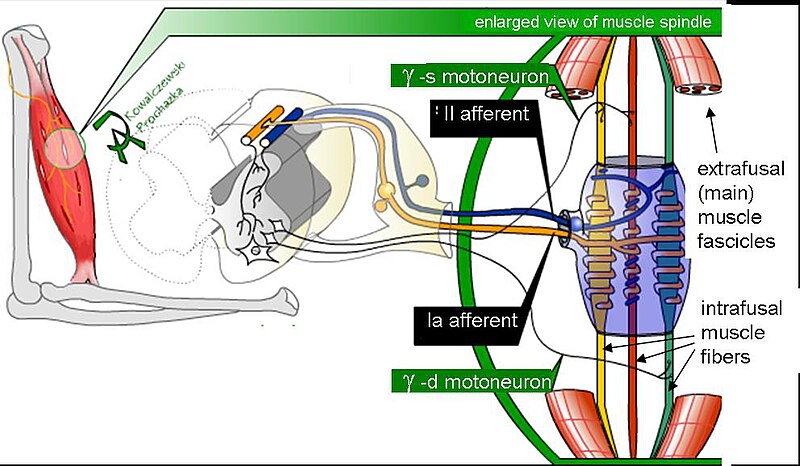
Your spine integrates the signals from the muscle spindles and creates a loop back to the biceps muscle via motor neurons which control the biceps' movement. The signals sent from the spine to the bicep muscle tell your bicep to contract, effectively halting the bicep lengthening. Your spine also sends an additional motor signal to your triceps muscle, the muscle responsible for the opposite movement of the biceps. This signal is inhibitory and restricts contraction of the triceps muscle. If the triceps muscle were allowed to contract, it would counteract the attempts of the biceps muscle to contract. So by contracting the biceps muscle and by inhibiting contraction of the triceps muscle, the biceps muscle stops its lengthening and arm posture stability is maintained for the current load.
The stretch reflex is important to our bodies. Aside from maintaining posture, an important function of the reflex is to prevent injuries. The stretch reflex prevents your muscles from being overextended which could lead to possible tearing from the bone, a very painful injury. That is why it is important that this action is reflexive. Having to send signals to the brain can be too costly in regards to time. Having an integrated processing center in the spine allows the stretch reflex to occur on a millisecond timescale. A small amount of time that I'm sure your body appreciates.
To learn more about muscles, muscle spindles and the stretch reflex, check out this interactive website: http://www.angeltear.com/spindle/spindle.html or view the video below.

No comments:
Post a Comment